



A call from a private equity firm can feel like good news until the buyer asks for clean financials, forecasts, contracts, HR files, ownership records, and a working data room. Many business leaders feel ready for that call. Fewer have the records to back it up.
Milestone surveyed 500 founders, owners, CEOs, senior executives, and finance leaders at privately held businesses. We asked how prepared they feel for a sale or investment, which records they could hand over, and how long it would take to pull everything together.
Getting financials, HR files, and operations in order well before a sale is often called exit readiness, and the survey suggests most owners have more of it left to do than they think.
Key Takeaways
- Among leaders who have pursued a sale, investment, or financing, 18% say missing or disorganized records delayed a deal, changed its price, or caused it to fall through.
- 51% of business leaders feel prepared if a private equity firm contacted them today.
- Only 20% have an up-to-date data room to share business documents with a buyer.
- Business leaders estimate they would need about 3 weeks on average to gather a full package of records for an investor.
- 22% would rely on an outside accountant, while 38% would gather the records themselves without help.
- Across all leaders surveyed, 7% report accepting a lower valuation or sale price, losing a buyer, or walking away from a deal because of missing or messy records.
Leaders Feel Prepared for a Buyer, but Few Have a Data Room
Confidence runs ahead of paperwork. Many leaders say they could handle a buyer’s call, but far fewer have a data room, the place where business documents are shared with a buyer.
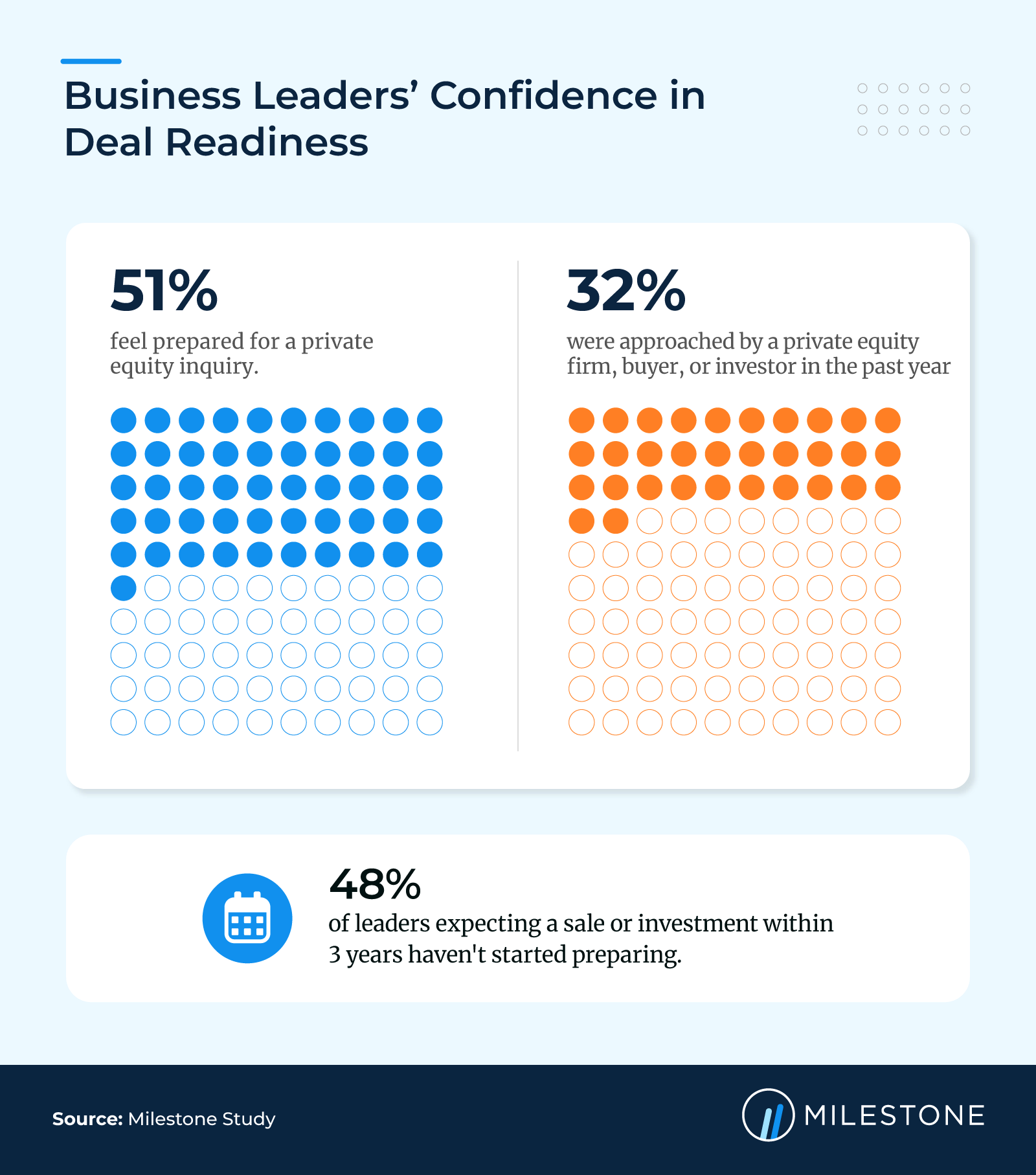
Only 19% say they are very prepared for a private equity inquiry. Confidence differs by generation: 78% of Gen Z, 52% of millennials, 43% of Gen X, and 42% of baby boomers feel very or somewhat prepared. It also rises with company size.
At companies with 250 to 499 employees, 92% feel prepared, compared with 38% at companies with 1 to 9 employees. Among CFOs and finance leaders, 90% feel prepared, compared with 45% of founders and owners. Revenue shows a similar pattern. Leaders at businesses with less than $1 million in annual revenue feel prepared at 44%, compared with 72% at $1 million to under $10 million and 75% at $10 million or more.
Buyer interest isn’t rare. About 30% expect a sale, investment, or recapitalization within three years. (Recapitalization means changing the mix of debt and ownership used to fund a business.) In the past year, 32% were approached by a private equity firm, buyer, or investor, including 54% of Gen Z, 37% of millennials, 21% of Gen X, and 23% of baby boomers.
If a firm reached out, 38% would first call an advisor, accountant, or lawyer. Another 18% would take the meeting, 15% would get their records in order, and 16% were unsure. About 13% would stall, delay, or avoid responding. Leaders who aren’t preparing give two main reasons: they don’t expect to sell or raise money (46%), or they are too busy running the business (42%).
Clean records rarely come together in a few weeks. Small businesses can bring in accounting services for small business long before a sale is on the table, so the books are already in shape when a buyer asks.
Advice From Business Leaders
Review documents before a buyer does.
“Run your own diligence before the buyer does. Get your financials, contracts, and key documents clean and organized early, and disclose known issues upfront. Surprises discovered late erode trust and price, while problems you raise yourself are usually negotiable.”
— Senior executive, IT or software, 10 to 49 employees.
Prepare before deciding to sell.
“Get your things in order today. Even if you’re not looking to sell. In my mind, that’s a good business decision.”
— Founder or owner, real estate, 50 to 249 employees.
Which Business Records Leaders Have Ready for Buyer Review
Having a few records is common. Having all of them is not.
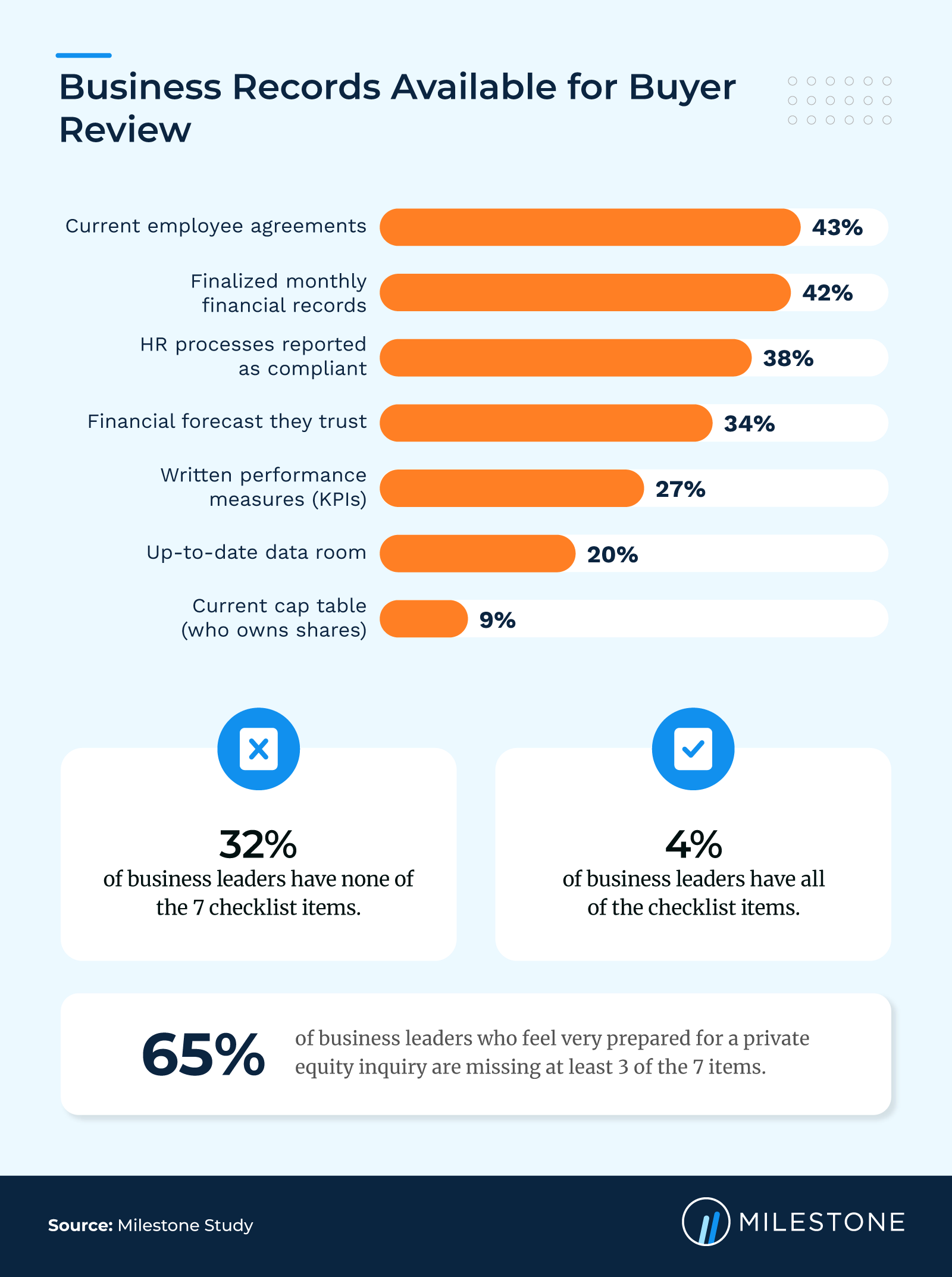
On our seven-item survey checklist, leaders report an average of 2.13 items, and 14% have five or more. Even among leaders who say they are very prepared, only 14% report all seven. In that group, 55% have no up-to-date data room, and 76% have no current cap table, a record of who owns shares in a business.
Buyers do ask. About a third of leaders (32%) have had a buyer, lender, or investor request documents. That includes 59% of finance or insurance leaders and 56% of IT or software leaders, compared with 25% in retail or e-commerce.
Industry and revenue shape what leaders have on hand:
- Retail or e-commerce had the highest share with none of the seven items (46%), compared with 11% in IT or software and 15% in finance or insurance.
- A trusted forecast was most common in IT or software (59%) and finance or insurance (49%), and least common in construction (21%) and healthcare (25%). Software companies that want a forecast a buyer will trust often look to accounting services for SaaS built around subscription revenue.
- Among leaders at businesses with annual revenue below $1 million, 44% manage finances on spreadsheets or gut feel without a formal system, compared with 12% at $1 million to under $10 million.
- Leaders at businesses with $10 million or more in revenue report an average of 4.22 checklist items, compared with 1.66 for those with less than $1 million in revenue.
- Checklist totals also differ by generation, averaging 2.52 items for Gen Z, 2.32 for millennials, 1.94 for Gen X, and 1.65 for baby boomers.
Buyers also look at people records, such as employment agreements, benefits, and payroll history. HR services for small business and payroll services for small business can keep those files current instead of rebuilt in a rush.
Advice From Business Leaders
Keep documentation in one place.
“I’ve gone through fund raises with multiple startups I’ve worked at. One piece of advice is to document everything in a single source of truth. Everything. As it happens. Even the simplest of processes. The idea is that someone else should be able to come in, look at your documentation, and know without confusion where everything is and how everything is done.”
— Senior executive, IT or software, 50 to 249 employees.
Check accuracy and consistency.
“The most essential piece of advice that I would offer is organizing your financial statements, contracts, and other important documents at the very beginning. It is essential for all of the information to be accurate and consistent, because even minor inaccuracies might be discovered during due diligence.”
— CFO or senior finance leader, healthcare, 50 to 249 employees.
How Long It Would Take to Gather Records for an Investor
If an investor asked for everything tomorrow, how long would the scramble last? Most leaders think in weeks, not days.
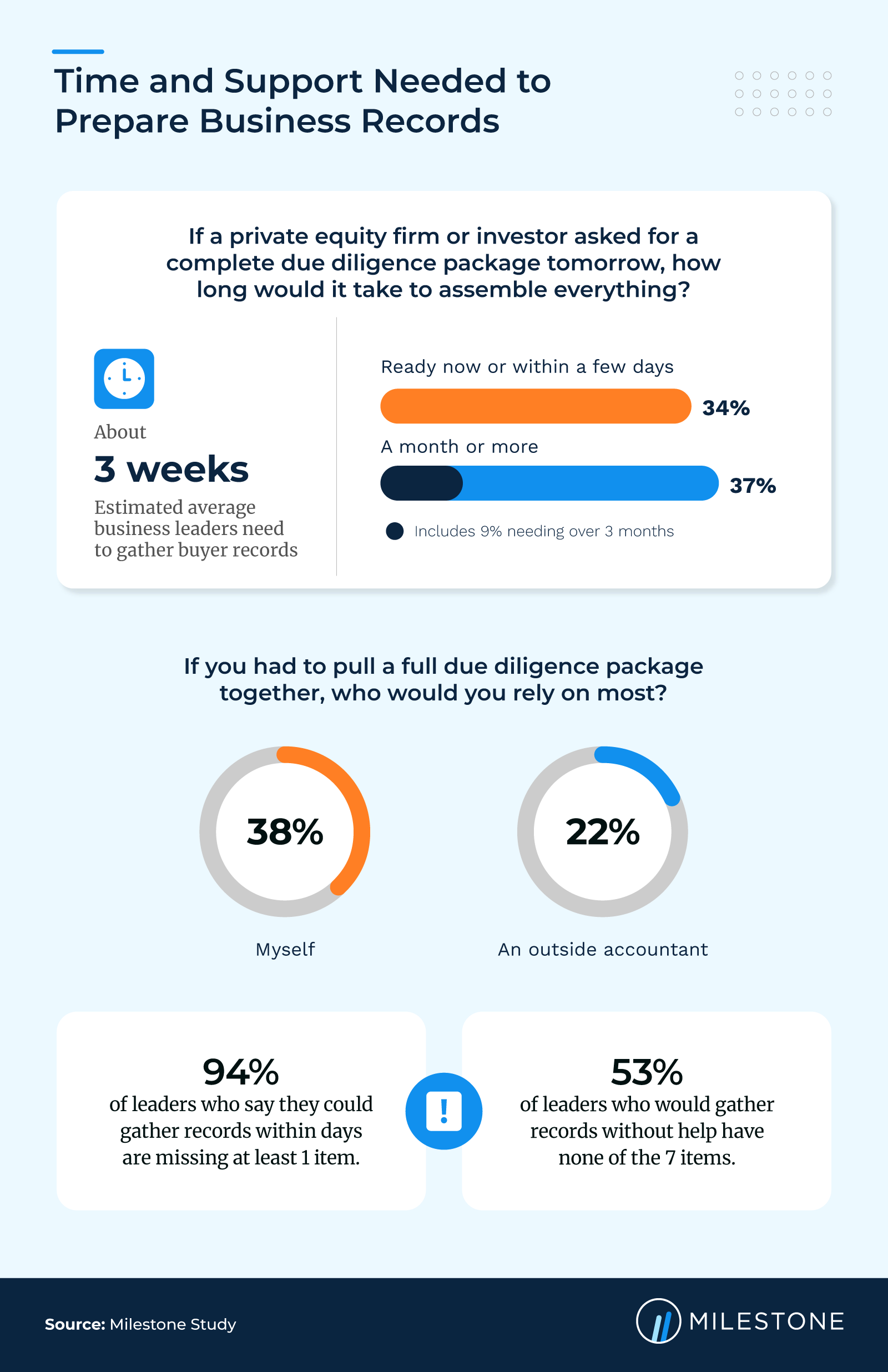
Confidence about speed doesn’t always match the records on hand. Among leaders who say they could gather records right now or within a few days, 23% report having none of the seven checklist items. Then there are 22% of leaders who say nothing would cause a last-minute scramble, yet 89% of that group are missing at least one item.
Many wouldn’t have much help. Beyond working alone or calling an outside accountant, 21% would rely on an internal finance team and 15% would turn to a lawyer or an advisor who helps with business sales and mergers. Going without help is far more common in some industries.
In retail or e-commerce, 61% would gather records on their own, compared with 28% in professional services, 23% in healthcare, and 18% in finance or insurance. By revenue, 47% of leaders below $1 million would work without help, compared with 12% at $1 million to under $10 million. The figure is 8% for $10 million or more.
Advice From Business Leaders
Start gathering records early.
“Get your financial records and key documents organized as early as possible. Being transparent and well-prepared can make the due diligence process much smoother and help build trust with potential investors or buyers.”
— CFO or senior finance leader, healthcare, 50 to 249 employees.
What Missing or Messy Records Have Cost in Deals
For some leaders, the scramble has already cost them.
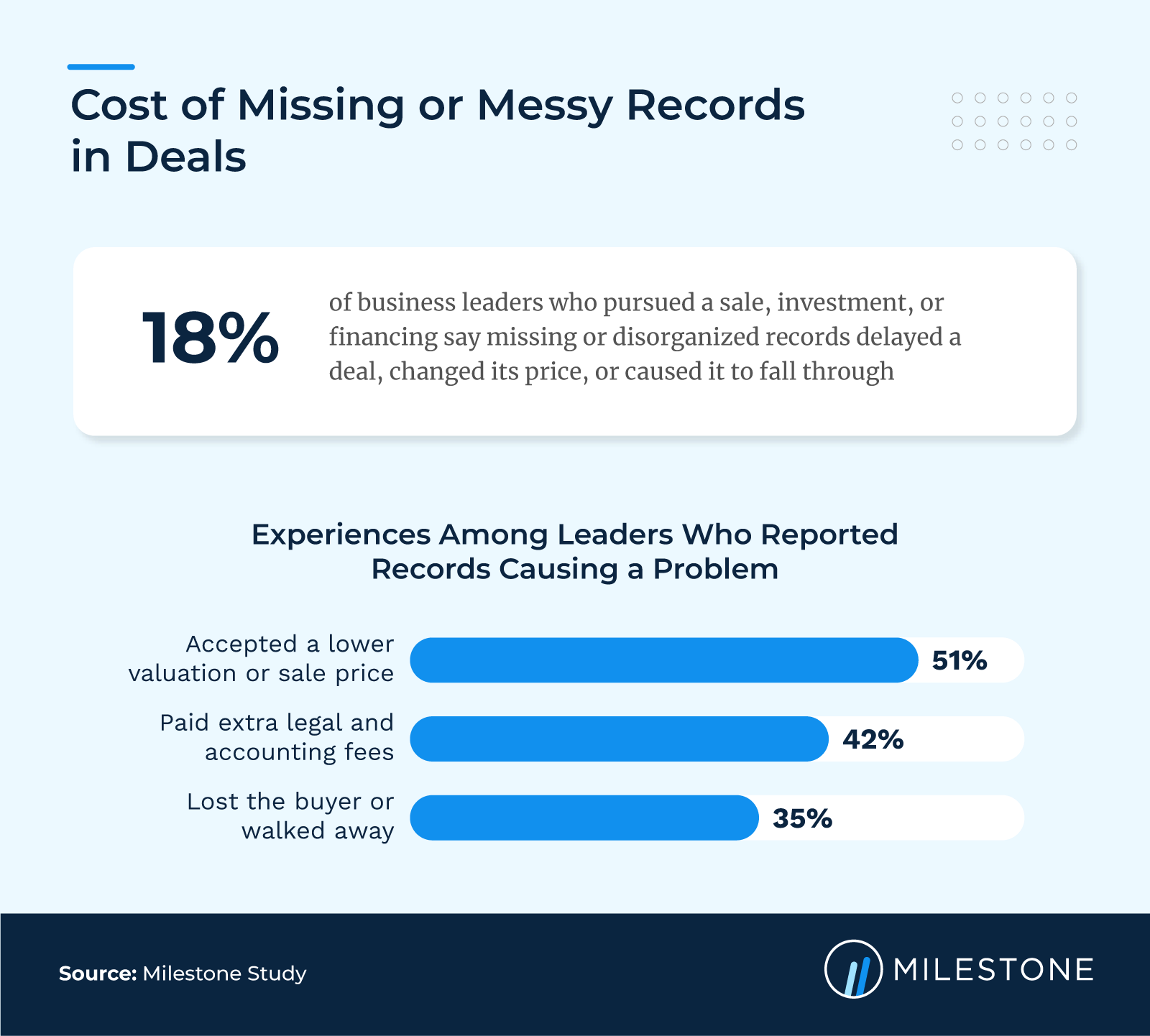
About 64% of surveyed leaders have pursued a sale, investment, or financing. Among all leaders surveyed, 11% say missing or disorganized records delayed a deal, changed its price, or caused it to fall through, and 7% report accepting a lower valuation or sale price, losing a buyer, or walking away.
Younger leaders have experienced more issues. Deal problems were reported by 32% of Gen Z, 13% of millennials, 5% of Gen X, and 4% of baby boomers. Company size matters, too: 38% of leaders at companies with 50 to 249 employees reported a deal problem, compared with 4% at companies with 1 to 9 employees.
Feeling Ready and Being Ready Are Different Things
Feeling ready and being ready aren’t the same. Many leaders feel prepared when a buyer calls, but the average leader has about two of the seven survey checklist items, and a current cap table is the least common of the seven. Financials and forecasts were the areas leaders most often said would cause a scramble, so they are a practical place to start. CFO services for small business can help owners build and maintain a forecast before a deal is on the table. Keeping every record current means a buyer’s first request doesn’t turn into a fire drill, and it’s the heart of exit readiness heading into any sale.
Methodology
For this campaign, we surveyed 500 founders, owners, CEOs, senior executives, and finance leaders at privately held businesses with fewer than 500 employees to explore how prepared they feel for a sale or investment, which business records they have ready, and how long they would need to gather documents for a buyer.
All participants were adults age 18 or older. Among them, 49% were men, 49% were women, 1% preferred to self-describe, and 1% preferred not to say. Generationally, 13% were Gen Z, 40% were millennials, 36% were Gen X, and 11% were baby boomers. Responses were self-reported and were not independently verified. Percentages were rounded to whole numbers.
About Milestone
Milestone provides outsourced accounting services, CFO, payroll, and HR services for startups and small businesses. Our dedicated teams support leaders with everything from day-to-day bookkeeping to strategic CFO guidance and exit planning, and we host exit readiness workshops that help owners prepare their financials, HR, and operations well ahead of a sale. Learn more at milestone.inc.
Fair Use Statement
You’re welcome to share these findings and visuals for noncommercial purposes. Please credit Milestone and link back to this page so readers can see the full study and methodology.
Related Content
Would Your Business Survive Due Diligence?
We surveyed 500 business leaders: 51% feel ready for a buyer, but only 20% have an up-to-date data room. See what records they ...

When to outsource your accounting and when you should hire internally
Outsource your accounting when financial complexity outpaces your internal capacity—rapid growth, rising transaction volume, missed deadlines, or no real-time ...

8 Keys to a Successful Outsourcing Relationship
Updated: Jun 15, 2026 Outsourcing has become a standard way for small and mid-sized companies to tap specialized expertise without the cost ...


Stay in the know